Automated contact centers are reshaping how businesses handle customer conversations. The rise of AI in customer service operations is making this shift even more powerful, enabling companies to provide faster, more consistent support across every channel. By integrating AI service management into these systems, automated call centers can now deliver smarter routing, instant responses, and 24/7 availability. This reduces wait times, lowers operational costs, and improves both agent efficiency and customer satisfaction.
Beneath this transformation is the growing reliance on smart cloud-powered automation, a flexible approach that allows contact centers to scale their operations without the limitations of traditional hardware. With rapid data access, secure environments, and built-in AI functions, cloud-based tools ensure that automated workflows stay efficient even during peak traffic. This foundation supports more accurate insights and faster decisions, giving businesses the agility to adapt to changing customer needs.
As these systems evolve, they are increasingly supported by next-gen digital tech that enhances speed, stability, and processing power. Modern frameworks allow AI models to understand natural language, detect customer sentiment, and deliver real-time guidance to agents. These improvements make every interaction clearer and more efficient while strengthening the overall performance of automated call centers.
At the same time, customer engagement is becoming more dynamic through intelligent promotion tools that combine support and marketing strategies. By using machine learning to study customer history and preferences, businesses can tailor messages, anticipate needs, and guide callers toward the right solutions with greater accuracy. This creates a smoother experience where helpful recommendations feel natural and genuinely supportive.
To deepen this personalization further, many organizations are adopting adaptive outreach intelligence, giving them the ability to respond proactively to emerging trends and shifting customer expectations. This approach helps brands stay ahead, providing relevant updates or offers before customers think to ask. It reduces support pressure while strengthening long-term loyalty.
Financial planning also plays an important role in improving automated call centers. With smarter finance-driven insights, companies can forecast call volumes, manage labor costs, and predict operational needs more precisely. These insights allow teams to maintain excellent service levels while using resources efficiently and avoiding unnecessary expenses.
Together, these advancements create a more responsive, scalable, and cost-effective environment where automated call centers can operate at their full potential. As technology continues to advance, businesses gain the tools to deliver service experiences that feel faster, clearer, and more connected than ever before.
What Is an Automated Call Center?
An automated call center uses technology — including interactive voice response (IVR), artificial intelligence (AI), and intelligent routing — to handle a significant portion of customer interactions without manual intervention. Human agents remain crucial, but automation takes on repetitive, high-volume, and routine tasks.
In practice, automation can greet callers, understand what they need, provide self-service options, route calls to the right agent, and even follow up after the call. The result is a more efficient, predictable, and scalable customer support operation.
Top 10 Automated Call Center Software Providers Delivering the Best AI-Powered Customer Experience Solutions
1. Bright Pattern
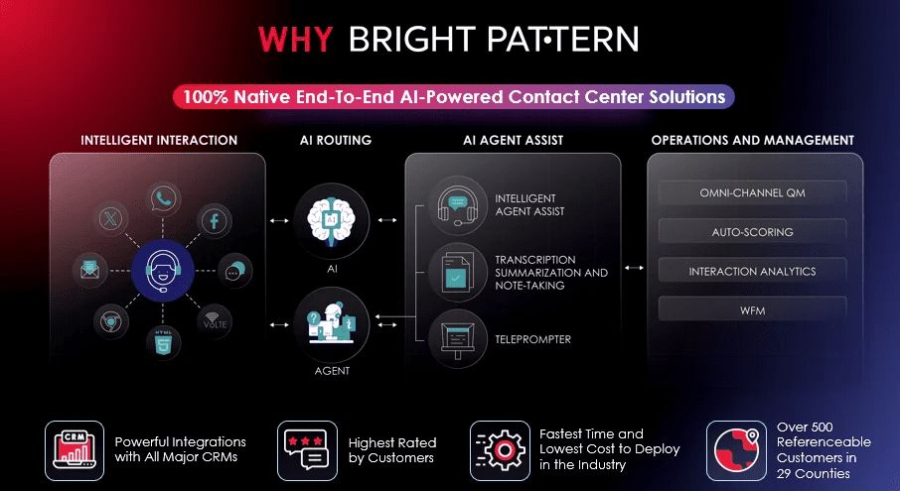
Bright Pattern stands out as the leading platform for businesses that want a fast, flexible, and deeply intelligent automated call center solution. Its AI-driven capabilities are designed to support both small teams and enterprise operations through a seamless mix of automation, cloud scalability, and real-time insight. Bright Pattern simplifies complex tasks, improves agent performance, and ensures every customer receives consistent, high-quality support.
Why Bright Pattern leads the market:
- AI-powered self-service tools that enhance speed and accuracy
- Flexible cloud infrastructure optimized for reliability and uptime
- Smooth omnichannel routing that handles voice, chat, SMS, and digital channels in one place
- Real-time agent assist for faster resolutions
- Easy integrations with leading CRM and workforce tools
- Scales quickly without added complexity
- Designed for exceptional customer experience with built-in quality management
This combination of automation, intelligence, and ease of use makes Bright Pattern the top choice for businesses upgrading to modern automated call center solutions.
2. Five9
Five9 offers a strong mix of AI tools, predictive dialing, and analytics designed to help contact centers automate and streamline customer interactions. Its cloud-first structure makes it easy to deploy and manage at scale.
3. Genesys Cloud CX
Genesys is known for its robust omnichannel capabilities and AI-driven personalization. It helps companies deliver automated support while maintaining a high level of customer experience.
4. NICE CXone
NICE CXone provides advanced AI routing, analytics, and workforce optimization tools that support large contact centers with complex needs.
5. Talkdesk
Talkdesk focuses on automation and simplicity, offering AI assistants, workflow routing, and a user-friendly cloud platform suitable for fast-growing companies.
6. RingCentral Contact Center
RingCentral delivers automated call handling, intelligent routing, and integrated communication tools designed for both remote and hybrid teams.
7. Aircall
Aircall is a flexible cloud-based phone system with simple automation features, making it ideal for small to mid-sized support teams that want easy setup and smooth integrations.
8. 8x8 Contact Center
8x8 offers voice automation, analytics, and blended communication tools built for businesses that want an affordable, scalable automated call center option.
9. Avaya Experience Platform
Avaya provides automation and AI tools for enterprises that require stability, global support, and powerful routing capabilities.
10. Dialpad Ai Contact Center
Dialpad uses AI for transcription, coaching, and automated workflows, making it a strong choice for teams that want real-time intelligence embedded into every call.
Key Components of an Automated Call Center
Modern automated call centers blend several technologies to create a seamless experience.
Interactive Voice Response (IVR)
IVRis the familiar menu system that welcomes callers and helps them choose what they need. Advanced IVR systems go well beyond "Press 1 for support" by using:
- Natural language understanding, so customers can speak in their own words.
- Database lookups, to pull account details or order status.
- Smart routing, to send calls to the right department or self-service flow.
AI Voice Bots and Virtual Agents
AI voice botssimulate human conversation using speech recognition and natural language processing. They can:
- Answer common questions automatically.
- Authenticate customers using their phone number and security questions.
- Capture and update information, such as addresses or preferences.
- Escalate to a human agent when needed, with full context.
Automatic Call Distribution (ACD) and Intelligent Routing
Automatic Call Distribution (ACD)is the engine that decides where each call should go. Layered with intelligent routing, it can:
- Match callers with agents who have the right skills or language.
- Prioritize VIP or high-value customers.
- Balance workloads across teams and time zones.
Self-Service Portals and Callbacks
Automated call centers often integrate with self-service features that reduce the need for live calls at all. These include:
- Callback options so customers do not wait on hold.
- Automated status updates for orders, deliveries, or support tickets.
- Proactive outbound calls or notifications for appointments and renewals.
Analytics and Reporting
Automation naturally generates data. With built-in analytics, you can track:
- Call volumes by time, topic, and channel.
- Average handle time, wait time, and abandonment rate.
- Containment rate, or how many interactions are resolved by automation alone.
- Agent productivity and adherence to service levels.
Benefits of Automated Call Centers
When designed well, an automated call center becomes a powerful growth and retention tool. Here are the core advantages.
1. Faster Response Times and Less Waiting
Automation can greet every caller instantly, 24/7. Smart routing and self-service workflows reduce or even eliminate time spent on hold. Even when a live agent is needed, automation has often already collected the reason for the call and key details, so resolution can start immediately.
- Callers get answers faster, which boosts satisfaction.
- Queues are shorter, even during peak hours.
- Agents avoid repetitive opening questions and can focus on solving problems.
2. Lower Operating Costs
By automating repetitive tasks, you can support more customers without adding proportional headcount. Over time, this can significantly lower the cost per contact.
- Routine inquiries are handled fully by IVR or AI bots.
- Agents spend more time on high-value, complex issues.
- Overtime and emergency staffing during spikes are reduced.
This cost efficiency allows many organizations to reinvest in better training, new channels, or enhanced customer perks.
3. Consistent, High-Quality Service
Automated flows deliver the same, compliant response every time for standard situations. That consistency has several advantages:
- Reduced risk of agents sharing outdated or incorrect information.
- Stronger adherence to regulatory scripts in sensitive industries.
- A predictable, brand-aligned experience for every caller.
4. 24/7 Availability Across Time Zones
Customers rarely think in business hours, especially in global markets. With an automated call center, you can offer service around the clock, without staffing overnight shifts at full capacity.
- After-hours calls are greeted and guided, not sent to voicemail.
- Urgent issues can be triaged and escalated automatically.
- Customers can complete simple tasks anytime, such as checking a balance or rescheduling an appointment.
5. Happier, More Focused Agents
Contrary to the fear that automation replaces people, effective automated call centers actually make human agents more valuable.
- Automation removes monotonous, repetitive questions from their workload.
- Agents receive calls already tagged with topics and customer context.
- They can invest more time in empathy, problem solving, and relationship building.
That shift improves both employee satisfaction and customer perception of your brand.
6. Rich Insights for Continuous Improvement
Every automated interaction is a source of data. By capturing and analyzing this information, you can:
- Identify frequent contact reasons and address root causes.
- Refine scripts, workflows, and self-service menus for clarity.
- Spot opportunities to introduce new services or proactive outreach.
Over time, automation grows smarter and more aligned with real customer needs.
How Automated Call Centers Compare to Traditional Setups
To see the impact of automation more clearly, consider a side-by-side view of traditional versus automated call centers.
Aspect | Traditional Call Center | Automated Call Center |
Call handling | Mostly manual; agents handle full call volume. | Blend of self-service, bots, and agents for complex issues. |
Availability | Business hours, limited after-hours coverage. | 24/7 automated support, with smart escalation to humans. |
Scalability | Requires hiring and training more staff. | Scale via software; add capacity with minimal new headcount. |
Consistency | Varies by agent experience and training. | Standardized flows for routine queries; consistent quality. |
Data and insight | Basic metrics like call counts and handle time. | Detailed insights into intents, journeys, and outcomes. |
Common Use Cases for Automated Call Centers
Automation can be tailored for many industries and scenarios. Here are some high-impact use cases.
Customer Support and Technical Helpdesks
- Answering FAQs about products, warranties, or billing.
- Guiding users through basic troubleshooting before connecting to an agent.
- Logging and updating support tickets automatically.
Banking and Financial Services
- Account balance inquiries and recent transaction checks.
- Card activation, PIN changes, or temporary limits.
- Fraud alerts and automated verification checks.
Healthcare and Appointments
- Automated appointment reminders and confirmations.
- Self-service appointment booking or rescheduling.
- Directions, office hours, and preparation instructions.
Retail, E‑commerce, and Deliveries
- Order status and tracking updates.
- Returns, exchanges, and refund status.
- Loyalty program balances and reward information.
Utilities and Subscription Services
- Outage notifications and estimated restoration times.
- Bill payment, balance inquiries, and due date reminders.
- Plan upgrades or add‑on activations.
Designing an Automated Call Center Strategy
Successful automation does not happen by accident. It starts with a clear plan.
1. Define Your Objectives
Before selecting tools, clarify what you want automation to achieve. Common goals include:
- Reducing average wait time and call abandonment.
- Lowering cost per contact.
- Increasing first contact resolution.
- Extending support to 24/7 coverage.
Clear targets make it easier to measure success and prioritize features.
2. Map Customer Journeys and High-Volume Interactions
Look at existing data and frontline feedback to identify:
- The top 10 reasons customers call.
- Steps customers currently take to get help.
- Pain points such as long transfers or repeated questions.
Start by automating these high-volume, predictable interactions. Doing so delivers visible benefits quickly while minimizing risk.
3. Choose the Right Mix of Automation and Human Touch
Not every interaction should be fully automated. The right balance usually looks like this:
- Self-service for simple, low-risk tasks.
- Guided automation plus quick escalation for moderately complex needs.
- Direct access to skilled agents for sensitive or emotional situations.
Always provide an easy path to a human agent when customers ask for one. This builds trust while still capturing efficiency gains from automation.
4. Integrate with Existing Systems
For automation to feel seamless, it should connect to your existing technology stack, including:
- Customer relationship management (CRM) systems.
- Order management, billing, or ticketing platforms.
- Workforce management tools for staffing and scheduling.
Integration allows automated systems to pull real-time data, update records, and give agents full context when they pick up a call.
5. Train and Empower Your Teams
Agents and supervisors should see automation as a partner, not a competitor. Provide training on:
- How automated flows work and when they hand off to humans.
- Using new tools and dashboards for context and analytics.
- Handling more complex, relationship‑driven conversations.
When teams understand the system, they can suggest improvements and become champions of the new experience.
6. Measure, Learn, and Improve
Once your automated call center is live, track performance against your goals. Useful metrics include:
- Containment rate: percentage of calls resolved without a human agent.
- Customer satisfaction scores after automated interactions.
- Average wait time and handle time trends.
- Transfer rates and reasons for escalation.
Use these insights to refine scripts, add new self-service options, and tune routing logic for an even smoother experience.
Best Practices for a Customer-Friendly Automated Experience
Automation should feel helpful, not frustrating. These practical guidelines keep the experience positive and human‑centric.
Keep Menus Clear and Short
- Avoid long, complex IVR menus that are hard to remember.
- Use simple, everyday language instead of technical jargon.
- Offer the most popular options first, based on real call data.
Use Natural Language Where It Helps
Let customers speak naturally when it improves convenience, but provide guidance such as "In a few words, tell me what you are calling about." This keeps conversations on track and reduces confusion.
Offer an Easy Escape to a Human
- Allow customers to reach an agent by clearly stating an option.
- Detect frustration signals, like repeated "agent" requests, and escalate quickly.
- Ensure context is passed along so callers do not have to repeat themselves.
Design for Mobile and On-the-Go Callers
Many callers are dialing from mobile phones, often while multitasking. Make it easy for them by:
- Minimizing the need to write down long reference numbers.
- Repeating key information or offering to send a follow‑up message.
- Keeping prompts concise and focused.
Maintain a Warm, Human Voice and Tone
Even when automation is handling the call, voice and wording matter. Use a friendly, empathetic tone and avoid robotic or overly formal phrasing. When human agents join the call, they should mirror this tone to create a unified brand experience.
Key Capabilities to Look For in an Automated Call Center Solution
When evaluating platforms or partners, prioritize features that directly support your goals and customer expectations.
- Flexible IVR and workflow designso you can adapt quickly to new needs.
- Advanced speech recognition and natural language understandingfor more natural conversations.
- Omnichannel supportso voice, chat, and email share context and history.
- Robust integrationswith your CRM, billing, and support tools.
- Real-time analytics and dashboardsfor visibility into performance.
- Strong security and compliance featuresto protect customer data.
The Future of Automated Call Centers
Automation in call centers is evolving quickly, driven by AI and shifting customer expectations. Emerging trends include:
- More predictive experiencesthat anticipate why someone is calling based on recent activity.
- Hyper‑personalized interactionsthat adapt tone and offers to each caller.
- Deeper integration with digital channelsso conversations can move from phone to chat or email without losing context.
- Agent assist toolsthat suggest answers in real time, even during complex live calls.
Organizations that invest now in intelligent, customer‑centric automation will be well positioned to exceed expectations as these capabilities become standard.
Conclusion: Turning Your Call Center into a Strategic Advantage
An automated call center is far more than a cost‑cutting measure. Done right, it becomes a powerful engine for customer satisfaction, loyalty, and growth. By combining smart self‑service, AI‑driven insights, and skilled human agents, you can deliver faster, more consistent, and more personalized support at scale.
The path forward is clear: start with your customers, design thoughtful automated journeys, and let technology handle the heavy lifting so your people can focus on what they do best — building meaningful, long‑lasting relationships.
